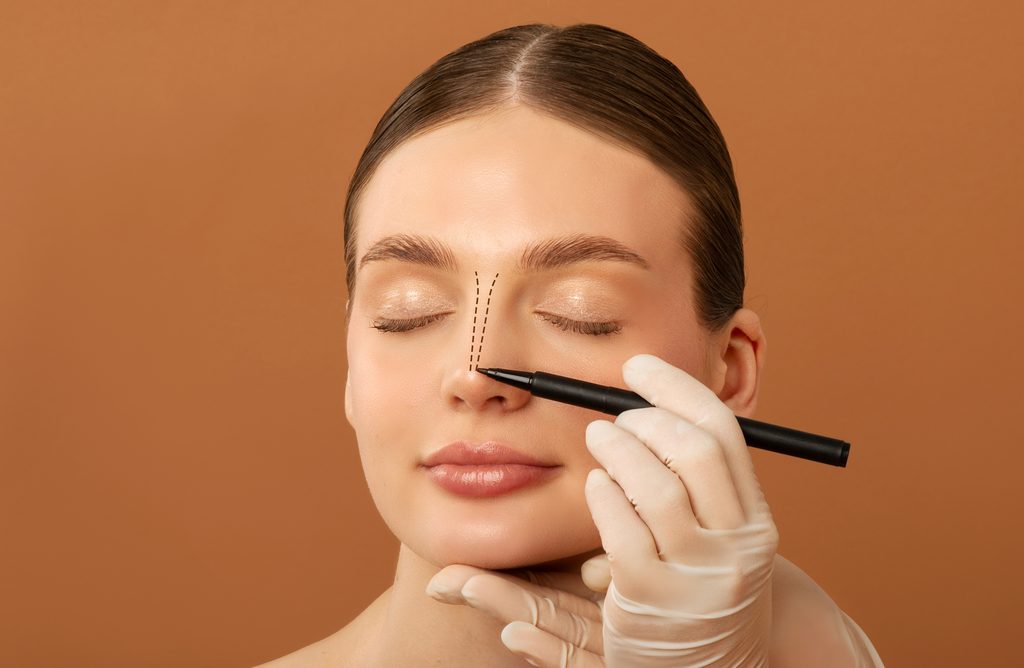
Most people who look into a nose job are not asking for a new face. They want the bump softened or the tip refined, and they want to still look like themselves in photos. That is harder than it sounds. Walk around Beverly Hills and you can spot the difference between a nose that was rebuilt and one that was quietly improved. The first announces itself. The second just makes the whole face look balanced, and nobody can say why.
So which technique gets you there? The approach matters, but it matters less than what the surgeon chooses to leave alone.
Proportion Beats Size Every Time
A nose does not look good or bad on its own. It looks right or wrong next to your brow, cheeks, lips, and chin. Two people can have the same profile, and shaving the same millimeter off each can improve one face and unbalance the other.
This is why the smallest nose is rarely the best nose. Take too much away and the face loses its center. The eyes look wider apart, the chin looks heavier, and something reads as off even to people who cannot name it.
Open and Closed: What Actually Differs
There are two main ways into the nose. Open rhinoplasty uses a small incision across the columella, the strip of skin between your nostrils, and lifts the skin so the surgeon can see the structure directly. Closed rhinoplasty, also called endonasal, keeps every incision inside the nose.
The visible scar is what people focus on, and with the closed approach there is none on the outside. The more interesting difference sits underneath. Lifting the skin envelope in an open case means releasing ligaments and supporting tissue that hold the tip in position. Surgeons rebuild that support with grafts and sutures, and skilled ones do it well. Still, you are replacing structure rather than keeping it.
Why Preservation Is the Real Answer
The technique most associated with natural proportions is a preservation-minded closed rhinoplasty. Instead of taking the framework apart and reassembling it, the surgeon works through internal incisions and adjusts only what needs it. Ligaments stay attached. The tip keeps its own support. Swelling tends to be milder, because less tissue was disturbed.
Preservation is the reason the closed technique keeps coming up in conversations about natural results. When the framework stays intact, the nose settles into a shape that still belongs to your face. People who go looking for the best Beverly Hills rhinoplasty surgeon are usually looking for exactly that mindset, even if they would not describe it in those words. They want a nose that looks like it was always theirs.
Dr. Deepak Dugar is a useful example of how narrow that focus can get. He is double board-certified and has built his entire Beverly Hills practice around closed, scarless rhinoplasty, which is unusual in a field where most surgeons offer a long menu of procedures. That kind of repetition is one of the things to look for, because millimeters decide the outcome here and experience with a specific technique is not interchangeable.
Closed Is Not Right for Every Nose
Here is the part with a lot of marketing skips. Closed rhinoplasty has limits. Complex revisions, severe trauma, and cases needing major reconstruction are often better served by the open approach, where direct visibility helps. A surgeon who says one technique solves every problem is selling, not advising.
Interest in this surgery keeps climbing. The American Society of Plastic Surgeons reported 48,423 nose reshaping procedures by its member surgeons in 2024, a 2 percent rise over the year before. More patients are also asking for subtle changes rather than dramatic ones, which puts real pressure on technique.
Look at the Whole Face, Not Just the Nose
Sometimes the nose is not the only issue. A weak chin makes a normal nose look large in profile, and a small chin implant or a bit of filler can improve balance more than aggressive nose surgery would.
Ethnic identity belongs in this conversation too. A well-planned nose respects the features you inherited instead of pushing every patient toward the same narrow profile. Losing that is how results start looking generic, and it is one of the most common regrets patients describe years later.
What to Ask at a Consultation
Bring specific questions. Ask which technique the surgeon recommends for your anatomy and why. Ask how often they perform it. Ask to see before and after photos of patients whose starting nose looked like yours, not only the most flattering cases. Ask what they plan to preserve, not just what they plan to remove.
Pay attention to how they answer. A surgeon who slows down, points out what already works on your face, and talks you out of changes you do not need is usually the one worth trusting.
Recovery Asks for Patience
Most people are presentable in about two weeks, once the cast is off and the early swelling drops. That is not the finish line. The tip is the slowest area to settle, and small refinements keep showing up for a year or longer. Judging your result at week three is the fastest way to talk yourself into a panic you did not need.
Final Thoughts
If natural proportions are the goal, a preservation-based closed rhinoplasty is the technique that most often gets there, because it keeps the support system your nose already has and refines the shape rather than replacing it. That said, the label on the technique is not a guarantee. A thoughtful surgeon using an open approach will beat a careless one using a closed approach every time.
The better question to bring to a consultation is not which method is best in general, but which method suits your nose and your face. Find someone who examines both before recommending anything, and you are far more likely to end up with a result that nobody notices and everybody somehow responds to.