Postpartum shedding is common and usually temporary. But when the shower drain is still filling with hair months later, or your parting looks wider instead of better, it is reasonable to ask whether something else is going on.
Pregnancy hair can be a bit of a confidence trick. For months, it may feel thicker, shinier and unusually well behaved. Then the baby arrives, sleep disappears, and somewhere between feeding, washing bottles and trying to remember when you last ate a proper meal, your hair seems to start leaving too.
For many new mums, the shedding is most noticeable in the shower or while brushing. Strands collect on clothes, wrap around the baby’s fingers and appear in corners of the house you could have sworn you had just cleaned. It can feel alarming, especially when nobody warned you how dramatic a normal change in the hair cycle can look.
The reassuring part is that postpartum hair shedding is usually temporary. The less reassuring part is that not every case follows the same timetable. If the shedding continues, the density keeps dropping or the hair never seems to recover, it is worth looking beyond the phrase ‘postpartum hair loss’ and checking what is actually happening.
Why does hair shed after having a baby?
Hair follicles move through a cycle of growth, transition, rest and shedding. During pregnancy, higher hormone levels can keep more hairs in the active growth phase for longer. That is why hair often feels fuller even though the body has not suddenly created a new set of follicles.
After childbirth, hormone levels shift again. A larger-than-usual number of hairs can enter the resting phase together and then shed a few months later. Dermatologists call this telogen effluvium. It commonly becomes noticeable around two to four months after delivery, although the timing and intensity vary.
This is not the same as the follicles dying. In a straightforward case, the cycle gradually resets and new growth follows. The short, wispy hairs around the hairline that refuse to lie flat can be annoying, but they may also be a sign that regrowth has begun.
How long is too long?
There is no stopwatch that marks the exact day postpartum shedding should end. Many women notice improvement within six to twelve months after birth, but recovery can be slower when sleep, nutrition, illness, stress or another hair condition is involved.
What matters is the direction of travel. Is the shedding easing? Are the thin areas beginning to fill in? Can you see short regrowing hairs? Or is the parting continuing to widen, the temples becoming more visible or the overall density falling month after month?
It is sensible to arrange an assessment when:
heavy shedding is continuing for many months without any sign of slowing;
the centre parting is gradually widening or the crown looks increasingly sparse;
you have distinct bald patches rather than diffuse shedding;
the scalp is painful, very itchy, inflamed, flaky or covered with thick scale;
you are also experiencing marked fatigue, dizziness, weight change, palpitations or feeling unusually cold;
your periods have become very heavy or irregular, or you have other signs of a hormonal problem;
hair loss started before pregnancy and appears to have progressed after delivery.
Postpartum shedding can uncover another type of hair loss
Sometimes childbirth does not create a new hair condition so much as reveal one that was already developing quietly. Female pattern hair loss, for example, can cause gradual thinning over the top of the scalp and a widening central part. The extra shedding after birth may make that loss suddenly easier to see.
Other possibilities include iron deficiency, thyroid problems, low vitamin levels, alopecia areata, scalp inflammation, traction from tightly tied hairstyles and breakage from repeated heat or chemical processing. More than one factor can be present at the same time.
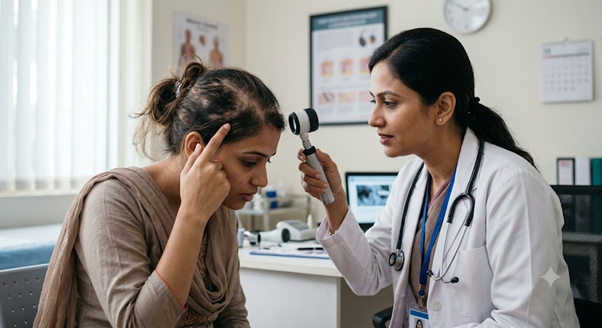
This is why a photograph alone cannot always tell the full story. A dermatologist may ask when the shedding began, whether it is improving, what your periods and diet are like, which medicines or supplements you take, and whether close relatives have pattern hair loss. A scalp examination or trichoscopy can help distinguish diffuse shedding from follicle miniaturisation, patchy loss and breakage.
When should blood tests be discussed?
Blood tests are not automatically required for every new mum who sheds hair, but they can be useful when the loss is prolonged, severe or accompanied by other symptoms. A doctor may consider a full blood count, ferritin or iron studies, thyroid testing, vitamin D or vitamin B12, depending on the history.
Ferritin can be particularly relevant after pregnancy when iron stores were low, there was significant blood loss during delivery, periods have returned heavily or the diet contains little iron. Results should be interpreted alongside symptoms rather than used as a reason to start high-dose supplements without medical advice.
What can you do while waiting for recovery?
There is no shampoo that can cancel a hormone-led shift in the hair cycle. Still, a gentler routine can reduce extra breakage and make the regrowth phase easier to live with.
Use a wide-toothed comb and detangle from the ends rather than pulling from the roots.
Keep ponytails, buns and braids loose, especially around the temples.
Reduce repeated straightening, bleaching and high-heat styling while the hair feels fragile.
Eat regular meals with adequate protein, iron-rich foods and a varied mix of nutrients.
Avoid taking multiple “hair vitamins” together unless a deficiency has been identified.
Change the parting or choose a shorter, layered cut if it makes the temporary loss easier to manage.
None of this is about doing postpartum recovery perfectly. Looking after a newborn can make even a basic meal or uninterrupted shower feel ambitious. The aim is simply to avoid adding preventable breakage or an unrecognised deficiency to a hair cycle that is already under strain.
When to book a medical assessment
An appointment with board-certified doctors at Kibo Clinics should begin with the pattern and timeline of the loss, not an assumption that every postpartum concern needs a procedure. The consultation may include a scalp examination, trichoscopy, review of medical and menstrual history, and targeted blood tests when symptoms point to a deficiency or thyroid issue.
Mention whether you are breastfeeding, planning another pregnancy or using any medicines. These details can affect which treatments are appropriate. A good consultation should also be honest when reassurance and monitoring are more suitable than intervention.
Which treatments might be discussed after diagnosis?
Treatment depends entirely on what the assessment finds. Ordinary postpartum telogen effluvium often improves with time, support for any confirmed deficiency and gentle hair care. It does not automatically need injections or long-term hair-loss medication.
When a dermatologist identifies female pattern hair loss, persistent follicle miniaturisation or another ongoing condition, the conversation changes. Options may include topical treatment, management of scalp disease, correction of a proven nutritional problem or other doctor-led approaches. Suitability during breastfeeding or while trying to conceive must be discussed before starting medication.
For selected women with persistent thinning and active follicles, PRP therapy for hair regrowth may be discussed as a supportive procedure. It uses a platelet-rich preparation derived from the patient’s own blood and is injected into the scalp. Research is more relevant to diagnosed pattern hair loss than to normal, self-limiting postpartum shedding, so it should not be presented as a default post-baby treatment.
PRP cannot create new follicles in a long-standing smooth bald area, and response varies. Preparation methods and treatment schedules also differ between clinics. If it is suggested, ask why it fits your diagnosis, who will perform it, how progress will be measured and what outcome is realistic.
What about minoxidil?
Minoxidil may be used for some forms of female pattern hair loss, but it is not something to start casually during the postnatal period. Breastfeeding status, pregnancy plans, scalp sensitivity and the actual diagnosis all matter. Discuss the risks, benefits and timing with a dermatologist rather than relying on a product recommendation from social media.
The same caution applies to tablets, hormone-influencing medicines, compounded products and high-dose supplements. ‘Natural’ does not automatically mean suitable during breastfeeding, and combining several products can make side effects or test results harder to interpret.
Questions worth taking to the consultation
Does this look like expected postpartum shedding, or is another condition visible?
Are there signs of female pattern hair loss or follicle miniaturisation?
Do my symptoms suggest that blood tests would be useful?
Could any medicines, illness, diet changes or scalp problems be contributing?
Which options are compatible with breastfeeding or future pregnancy plans?
How will we know whether the hair is recovering?
When should I return if the shedding does not improve?
The bottom line
Postpartum hair shedding is common, visible and often emotionally harder than the phrase ‘it is normal’ makes it sound. In many cases, the follicles are simply readjusting after pregnancy and the hair gradually returns without an intensive treatment plan.
But persistent loss deserves more than endless reassurance. If shedding is not easing, the parting continues to widen or other symptoms are present, a dermatologist can check whether postpartum telogen effluvium is the whole explanation. The right next step may be time, a blood test, treatment of an underlying problem or a targeted hair-loss plan. It should begin with a diagnosis, not a promise.