
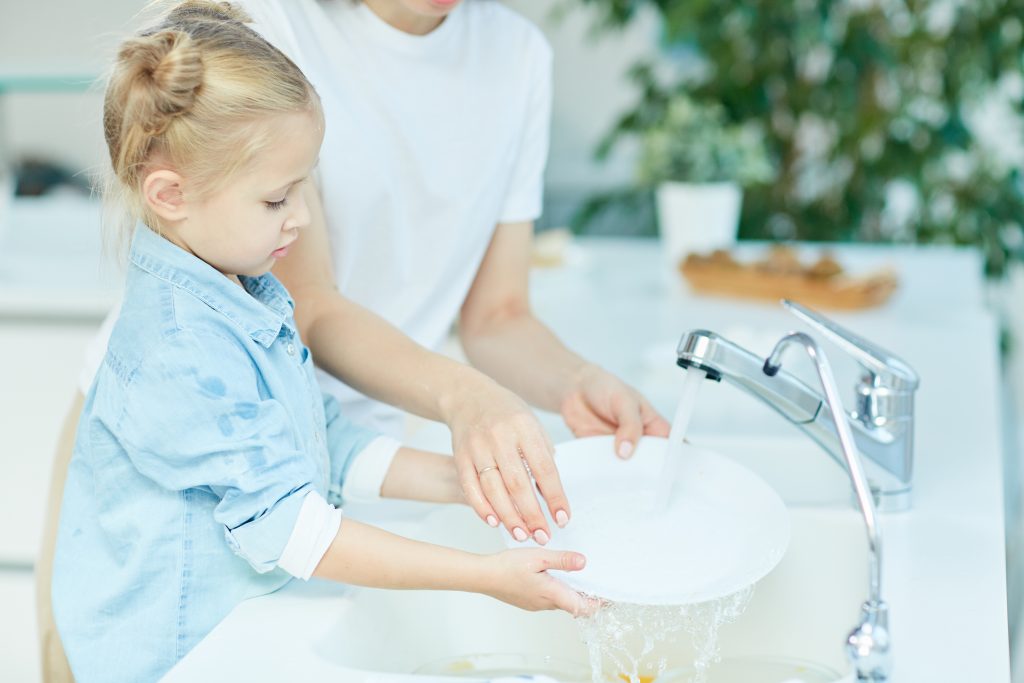
We all know that getting children to do chores and help out around the house these days is like pushing water uphill with a fork. Yet, most parents would like children to pull their weight on the domestic scene – not only because it would be a genuine help, but also because it would also genuinely help THEM in the long term too.
So the question is, how can we turn getting children to do chores and help out around the house from a constant battle to a Mary Poppins moment? Read on as Melissa Hood – founder of the Parent Practice returns with some stellar advice on how to encourage them to get stuck in.
Why should children do chores?
Children should do chores because chores are more than specific pieces of work done out of duty but they are life skills and doing them benefits the whole family as well as the individual child both in the present and for the future. Children who contribute to household tasks develop the following desirable attitudes or qualities:
- An awareness of the needs of others and a willingness to contribute to others’ wellbeing (this counteracts the sense of entitlement in children that many parents are worried about)
- A sense of connectedness to the family. This is vital for the child’s wellbeing as this sense of belonging fulfils a basic human need that helps them weather difficulties in the outside world
- A feeling of making a contribution to the family. We all need to be needed
- A sense of pride and accomplishment derived from the completion of tasks. This feeling of competency boosts confidence. A 2001 study on bullying by Oxford University’s Centre for Research into Parenting and Children linked responsibility for household chores to confidence which makes a child less vulnerable to bullying.
- Development of life skills
Studies have shown that involving kids in household chores from an early age gives benefits across their whole lives, such as completion of education, getting started on a career path, IQ, relationships with family and friends, and not using drugs. The researchers determined that the best predictor of young adults’ success in their mid-20s was that they participated in household tasks when they were three or four.
3-4-year-olds
Even quite young children can do jobs. 3-4-year-olds can wipe down a table and wash brushes after a painting session, put away toys after play and put clothes in drawers, thus learning that there are consequences to their actions and they need to take care of their own messes and look after their own things.
They can pull up a duvet and put a pillow on the bed, can put laundry in a hamper, sort clothes into darks and lights, feed (or help to feed) a pet, lay a table, take everyone’s plates over to the sink and even help vacuum and wipe down a sink after tooth-brushing. Doing these tasks will require teaching in small steps and supervising.
5-8 year olds
This age bracket can do all of the above a bit more independently and help unpack the dishwasher, assist in washing the car, put away groceries, fold washing, water plants and some dusting (watch the precious ornaments!) and gardening work such as raking and weeding (you may need to identify which ones are the weeds).
8-12 year olds
Children this age can add to that list emptying the washing machine and hanging washing on the line, washing dishes and pots and pans, putting rubbish bins out on collection day, cleaning up after pets, helping with food shopping and preparation, wiping down kitchen benchtops and bathroom surfaces and bathing independently.
Teens
Teenagers can also gradually take responsibility for planning and preparing simple meals, cleaning the fridge, toilet and shower, caring for younger siblings and ironing.

Why don’t children do chores?
It’s not rocket science. Nobody really likes doing the jobs around the house that need doing. Not many of us get real enjoyment from cleaning the toilet or the shower recess or the oven. Even stacking and unloading the dishwasher and making beds can drag. Vacuuming and dusting cease to be fun right about the time the child is old enough to do it properly.
But parents do all these things. Because someone has to. So why don’t we get our children to do them too when we say we believe in the value of chores? And the evidence is clear that children don’t do anything like the number of chores they did in the past.
Many parents don’t ask kids to do chores at all because
- They say the child is too young (query whether this means they are incapable or you think young children shouldn’t have any responsibilities?). As to their capacity to do the task parents tend to underestimate what a child could do when taught. In the past children took on many more of the household’s responsibilities than now.
- They believe school-aged children have enough to do with school work, that this is their ‘job’ (this prioritises academics and sporting commitments over making contributions to the family. It begs the question of our goals in raising children –is it to get them into the best academic institutions or is it to raise children who can balance caring roles with work)
- They anticipate that kids will ignore or resist requests to do tasks and don’t want to be nagging all the time (it’s quicker and easier and a lot less aggravating to do it ourselves). Children will naturally resist doing something unpleasant or uninteresting unless they seem some benefit in it and because their brains are not fully mature children have difficulty envisaging future benefits from a present inconvenience. It takes maturity and a positive parental attitude to get satisfaction from a job well done and to take pride in the contribution made to the smooth running of the household.
How do I get my children to do chores?
The best way to get children involved in contributing to household tasks is to change attitudes to and language around them. Move away from a coercive approach to one based on connection and motivation. Maybe don’t call them ‘chores’, but ‘responsibilities’ or ‘contributions’. I found that when I changed my language around tasks my children were much more willing to engage with them.
- Adopt a whole family approach to looking after the household. Everyone contributes according to their ability and allocations of tasks are made in family meetings in which the children have some input. Don’t just require children to do tasks associated with their own things such as tidying their rooms or making their beds but include jobs that benefit others too such as laundry or cooking or gardening.
- Require everyone’s involvement. The adults need to be really clear about why they are insisting on this because they will need to persist (See answers to question 1 above). Accept that you will need to supervise for a long time before the tasks become habitual. This will take longer than if you did it yourself (and the task won’t be executed to your standards) but your goal is to teach your child skills and attitudes for life not to get the floor mopped.
- Empathise that your child may not want to do what’s required and brainstorm ways to make it easier or more fun. What about setting aside some time for everyone to have a chore blitz and get all the tasks done together? Or putting on some music or listening to story recordings while you work? Or wearing funny hats while working?
- Appreciate everyone’s contribution. Use descriptive praise to motivate kids to keep doing their tasks. Give the children a sense of how valuable their contribution is.
Should I pay my kids to do chores?
Basic household tasks should be about contributing to the household as a member of the family. So I don’t think children should be paid for this. If you want children to have pocket money in order to learn how to manage money and appreciate it then either just give them a set amount or have them earn it by doing tasks above what they are expected to do at home.
What has been your experience of getting your children to do chores? If you have any hints and tips of your own why not add them in a comment below.



I found this really interesting , I’m disabled and I think when children do chores we’re quick to label the parents as bad and the children as young carers. But stuff like weeding the garden , hanging out the washing , sorting washing from blacks and whites , helping with cooking can be fun activities. I dont think children should be made to do stuff like hoovering though , hate hoovering
Our four-year-old is all about helping with chores. She loves to “sweep” and “mop.” I have to go back over it but she tries really hard.
I know my kids need to do more. They are teens and when I ask them to clean, they’re like “uhhh.” I don’t even ask for much because I don’t believe in having kids be live in servants and have lists of chores. But at least keep the bathrooms and bedrooms clean!
Thank you for writing this post. Its so important to get the kids involved in the everyday chores to help them in life.
Love this post! My daughter is two and she is already learning that there are systems/chores to be done each day.
These are awesome tips. I think it’s so important for kids to do chores. It instills a good work ethic in them and teaches them the value of working to help others.
My oldest is the only one who finally does chores on a regular basis. I look forward to my little ones getting there too.
It’s been a struggle here to motivate my kids to help out without getting paid. So we’ve agreed that certain chores they don’t get paid for and just have to do as their responsiblity. The other chores that are a little more time consuming they get paid for.
I believe having someone that scares them a little is helpful to make them do their chores. Hehe
Our kids had a few chores that they were responsible to do, but it rotated each week. That way, no one got stuck with the terrible one, or the super easy one. My sister-in-law is terribly sexist and her kids have “boy chores” and “girl chores.” I don’t think she’s helping them with that attitude.
I love this post. I think all kids should be helping around the house. I agree about them not being paid too. It’s part of life and they should all be helping out.
Chores are so important there is nothing worse than someone who is 18+ not knowing how to do laundry . Its also important for everyone to pull their own weight
We definitely struggle with getting the kids to do their chores. These are good points in getting them to be more involved.
These tips are wonderful! I believe that we should let the children help while they are still young. We need to teach them to be responsible so they will grow responsible. Thanks for sharing this.
Chores are really good for kids. They teach lessons and helps out mom and dad!
This is such a great read especially for first time parents. It is not bad to let our kids help to do the chores, it’s empowering and letting them value the things around them.
This reminds me of how much I didn’t like doing chores around the house. Now, as an adult, it’s incredibly important to get kids involved in household chores early on. This is a great read. Thank you for sharing.